


In March, 2008, I received a new right hip. It was supposed to be the latest, most innovative hip manufactured by DePuy, a subsidiary of Johnson and Johnson. I did not know much about joints or hip replacements before this procedure other than they are what “old” people have or those who have over-exercised their joints. I knew I had congenital arthritis from a birth defect known as dysplasia which affects a certain percentage of the population. I was a dancer, (not professionally, just a passion), former cheerleader,
a mom, wife, professional person, business owner, I was armed with internet research. I asked my doctor if my device had any recalls or complaints with the FDA. All indications were, this was one of the most successful surgeries in general. The device, heavily recommend by my physician was a metal on metal hip or MoM implant. It would wear at least 20 years and it is what all baby boomers and professional athletes who needed new joints were receiving (according to my surgeon). The surgery, if you have ever seen on YouTube, is pretty brutal. They use tools that reside in your garage; hacksaw, drill, hammer and chisels. They dislocated the hip, saw off the head of the joint, ream out the hip socket, drill out the bone marrow in your thigh and tap in a 7 inch (est.) long metal “stake” in your thigh. They put a ball on the end, (metal, ceramic or combination of both), and then put a cup made of metal or plastic in the socket as you would have a ball rolling about in a bowl. They have different size cups and balls for every size but much depends on the skill of the surgeon. You can come out with a limp and face future dislocations, have one leg shorter than the other, or the best and most widely touted case is you will fare better off than you were before and be pain free! The surgery went as expected. I went home after two days but had significant back pain – unusual for me since I never had any back issues prior to the surgery. I just assumed it was the result of a bad hospital bed. Within two weeks I was walking without a cane and felt relief overall that the surgery was over but still had pain in the back and a deep burning at the incision point. Then, as they say, it went downhill from there. For the next year, the pain intensified. I had rehab at home and then outside PT for over a year. Women are very unique in that they have an organ called a uterus; something that is pretty important when you start sawing around our pelvises. My physical therapist and I discussed at length the origins but she was baffled by it. I saw my surgeon several times after the surgery. He was confused as well, or so I thought. He sent me to a spine surgeon and another orthopedic physician. I was shot with steroids, anti-inflammatories and diagnosed with a myriad of possible causes but the prosthetic was never questioned. After almost a year of this, my doctor said there was nothing he could do to help me and “could not take the hip out”. That was a direct quote. Maybe in another year it would be better. I left his office and hoped it would all mend itself in time but continued to see other doctors, research possible causes of my pain and took a lot of Advil. I tried to strengthen my muscles and went to PT religiously. All the X-Rays, CT’s and MRI’s etc. initially showed nothing was wrong.
I stopped going to the gym/power walking which was something I had done since my mid twenties. My quality of life was non-existent. Women are so good in dealing with pain and I was no different; you also have your pride and do not want to burden anyone as everyone has their own problems and yours most certainly pale in comparison to others when you hear them. Due to the hip instability, injuries started to occur. I pulled hamstrings, fell down stairs, ripped tendons in my foot and broke six ribs. I was like the Scarecrow in The Wizard of Oz; I was just put back all wrong and now, like an ill-fitted engine, I was “burning” other parts that I should not be burning. After I fell and sprained my right ankle, I was put into a boot cast. I had to go on several trips and conventions that required much walking. This just exacerbated the pain but then I started to hear loud “clunks” in my hip. I had heard these before but now they were very audible. I thought despite the X-Ray’s claim the replacement was solid, it was loose. I got on the internet and thought I would search my implant maker once again to see if any new findings appeared. I heard nothing from my doctor in over a year. I had also seen another doctor in this period who ordered many expensive tests but did not give me any new feedback on the cause of the pain. I stayed up most of the night researching and in the morning, I understood not only the smoking gun, but the pistol, bullet, trigger and the tipping point in a very lucrative industry, both in joint replacement and orthopedic care in the US and globally. Two explosive articles in the New York Times by Barry Meier on March 3rd and 10th, 2010 uncovered a system not unlike industrial pollutants, big tobacco and the auto industry with the recall of Toyota gas pedals. It involved doctors and hospitals from around the globe, the FDA, and Medicare. This device, and many other metal on metal devices by other manufacturers were failing at an alarming rate – they were only lasting one to two years vs. the 20 years they were marketed as. The US currently implants five times more hips than any other industrialized country or over 250,000 a year with nearly one-third of those being metal on metal. Over 93,000 people may have been implanted with the DePuy ASR system worldwide and many were coming apart inside of them at a very rapid rate. The revisions are painful, risky, and very expensive. Finally, I had an explanation for the pain. But what was the next step to fix it? Call the surgeon and ask what he knows and figure out how you get it out? What do you put back in? In the meantime, DePuy was giving no information to patients. This is a Johnson & Johnson company; no stranger to product defects and consumer product liability charges. With this many people affected and occurring all at once, I wanted to find why it was failing. I had other symptoms I could not figure out either and now they all made sense. I was never hungry, lost weight and had a strong metal taste in my mouth.
Not so in the US. The articles in the Times go into the political and monetary reasons why but it all comes down to money, lawyers, defiant manufacturers and a government system asleep at the wheel. Take five minutes to read this article and you will not have anything put inside of you, a friend, or family member, without great pause. http://www.nytimes.com/2009/06/11/business/11device.html The FDA has over 400 complaints (and counting) on the DePuy device alone of painful and costly revision surgeries. I have talked to seven doctors in the US, the Mayo Clinic, Rush Hospital, read countless research from the Journal of Anthroplasty and six doctors in four countries. I am shocked by what I learned. People had infections so acute they had to have their hips removed, sewn up without them, placed in a wheelchair for five months to heal in order to return to the hospital for a new hip. Why haven’t we heard more about this? Because people have settled out of court and they can’t talk about it but soon lawyers will be on TV and when that occurs, it will get broader exposure. In the meantime, patients who have settled in most cases have to in order to move on from the tremendous emotional and physical toll and move on. The manufactures’ count on it. Who pays for all this? We all do. The insurance companies pay millions in unnecessary revision surgeries and it gets passed on to everyone in higher premiums. I spoke to people who got divorced and families who filed for bankruptcy. None of this should have happened with a national joint registry or, the "lowering of the bar to entry", the 510(k) at the FDA which allows companies like Johnson & Johnson to fast track their devices based on already approved patents without benefit of long and expensive clinical trials. J & J sees people as part of collateral damage on their risk management models and should come forward and tell the truth. Instead, they seem to set “X” aside for the settlements and trials and “Y” for claims if moved to Class Action status by the Courts taking years to litigate with patients getting next to nothing in monetary benefits. prada doctors bag purple prada purse million followers instagram prada brown bags legit instagram followers prada thong underwear tienda prada gucci things prada earmuffs dhgate prada loafers chatgpt ethics pr17ws prada instagram statistics followers chatgpt similar ai prada rossa black fruit with spiky outside prada inspired bag prada 18wv eyeglasses tamagatchis chatgpt ban dr jacob amrani prada purses outlet how to make a fake mustache with makeup williams chicken locations chatgpt turnitin chicken williams off brand gucci chatgpt writing prada boxers prada crystal sandals kim kardashian prada prada bags outlets tommy hilfiger factory stores dhgate prada loafers prada ring womens active followers instagram prada madrid growing colors by bruce mcmillan pie jesus meaning best prada perfumes outlet online usa prada cologne l'homme how to cut rambutan coachoutlet coach com mens prada trainers brunello cucinelli outlet online prada jeans womens prada mens jewellery gucci deutschland instagram followers 5k cartera prada negra tamagotchi new prada store online gucci online shopping athleta factory outlet locations opoli vs uber prada silver pumps tomagachis prada sticker prada luna ocean גוצ י david cronenberg jason x glasses prada women's tamagotchi pet prada adidas superstar shoes outlets new prada shoe amazing grace native american followers instagram app 5k followers instagram prada bag repair kpop instagram followers prada lotion random instagram followers prada sweatshirt women nike outlet shoes online gucci .com usa prada warranty prada nylon dupe shop premium outlet yacht caps prada water splash real captain hat cost of chatgpt burberry wallet outlet yacht club hat identity ray liotta llt academy south bay sabrina designs gucci bags official website prada mens shirt 10 instagram followers prada leather shoes cardinal supply st louis wearing prada fake head chatgpt cli guess prada dupe prada 18wv eyeglasses copilot vs chatgpt prada purse cheap electric mashman helmet restaurants near rosemont chatgpt 代理 gucco 20k followers instagram instagram followers live chatgpt whatsapp sailing captain hat prada black reviews zefoy instagram followers prada handba gucci shoes and bags chatgpt? buy prada delta 12 10 kayak banning chatgpt new gucci shoes and bags prada vogue bing chatgpt 4 I have metallosis (metal poisoning) and osteolysis (tissue/bone damage) and have four times the amount of cobalt and chromium in my body than the average person. I have pain that is deep and pervasive I have gone to the “dark side” more times than I want to admit here. I think about the older people and especially older women (the device fails mostly in women due to their smaller frame) and what they are going through. This device may cripple you if left inside and many doctors who never put metal on metal implants in don’t know enough about the side affects just yet. X-Rays do not catch it either. You must have a 3-D CT to really see it. My doctor did have knowledge of this. He knew in December 2009, and may have known prior as well. In fact, he had no intention of telling his patients according to his office. They told me: “unless patients called complaining about pain”, there was not need to worry”. I just happened to call his office last month and found out the president of DePuy had flown in to have lunch with him. He put in over 350 implants which makes him a very good customer. I should mention that some doctors are paid consultants for these companies making millions of dollars on the side. Some don’t disclose this to their patients. You can draw your own conclusions. Through all this I found a surgeon who will try and fix me. He can’t promise what he will find when he gets in but he has a Plan A and B and probably a Plan C. He’s not afraid to be taped, take pictures, save the implant for use in research or lawsuits. I trust him and he listens to his patients. My revision surgery was Wednesday, May 19th at Sharp Grossmont Memorial in San Diego. The surgery had a few “covert” moments. Just before I went
into the OR, I gave my surgeon a letter asking that no DePuy rep would
be in the room as all sales reps are in surgery and that he needed to
give me the explanted device uncleaned for legal I had some rough nights with pain but got through them. My doctor told me the surgery was a bit more than he expected; the cup that fits in the acetabulum (hip socket) never grew into the bone of the socket. The ball (all metal) was worn on just one hemisphere and shiny on the other indicating the rough side was rolling around on one edge and thus causing all the tissue damage. He got the device and tissue out and put in a new device (Stryker) which I had researched ahead of time. Replaced hips will only last 15 years but I’ll cross that bridge when I come to it. The other hip has about 6 months left before it needs to come out but I have some new European/Australian contacts now that are helping me. As far as recovery, it goes slowly. No weight bearing for a month so crutches and walkers. I have a whole new appreciation for the elderly and handicapped and I feel badly for all the times I grew impatient with people in this position. Never again. The pain is still pretty acute so it’s too soon to tell how this new one will perform. Time will tell and the metal testing will shed light on the amount of metal still affecting me. I have learned a great deal and am still learning every day so hopefully I will come out of this an informed advocate for family and friends and the general public, not just on replacement parts, but on the wider scope of medical care. What happens will happen and I will take a day at a time. I intend to launch a very aggressive campaign to educate the consumer/patient and let Johnson & Johnson know that just because you can’t recall human parts (as they do quite easily for children’s remedies) this should not “go away” any time soon. This is a defective product inside thousands of Americans and patients worldwide. Thank you to my incredibly supportive family and friends. Without you, I would truly not be here today. |
|
|
|

 runner, hiker, and
gym rat. At about age 49, the arthritis was making itself known to me.
Since I am a business owner and now consultant, my livelihood and that
of my family depends upon my good health.
runner, hiker, and
gym rat. At about age 49, the arthritis was making itself known to me.
Since I am a business owner and now consultant, my livelihood and that
of my family depends upon my good health.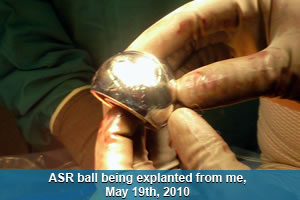 In December, 2009, I started experiencing what felt
like electric shocks in my back, thigh and hip. They would come a few
times a month. I consulted a new doctor about nerve damage and in our
quest to find the problem, he gave me several painful cortisone injections.
It got worse. Also, being self-insured, I faced many issues with coverage
most Americans are now aware of if you had time to read the 988 page
Health Care Reform Bill which covers what insurance companies can or
will not do at present.
In December, 2009, I started experiencing what felt
like electric shocks in my back, thigh and hip. They would come a few
times a month. I consulted a new doctor about nerve damage and in our
quest to find the problem, he gave me several painful cortisone injections.
It got worse. Also, being self-insured, I faced many issues with coverage
most Americans are now aware of if you had time to read the 988 page
Health Care Reform Bill which covers what insurance companies can or
will not do at present. But the reason you can’t find out the “why”, at least
in the US, is because we are the only industrialized modern healthcare
system (the one touted as the best in the world) that does not have a
national joint registry. Australia, who was the country responsible for
forcing DePuy to pull their product in December, 2009, has one. So does
the UK, Sweden, Germany, Switzerland, Canada and the list goes on. When
a surgeon puts a part in your body – knee, hip, shoulder etc. they
register the part. Then all the surgeons can monitor in real time a host
of performance issues about the devise; how it wears or doesn’t,
what happens if it starts to fail, why and who made it. All parts have
numbers like SKU’s and they are tracked. If a surgeon in Germany
puts in a Zimmer (another manufacturer) knee joint, all surgeons in the
registry know about it and the history. If a parts starts to show a pattern
of problems, it is investigated and most doctors will cease to use it
until the results are in.
But the reason you can’t find out the “why”, at least
in the US, is because we are the only industrialized modern healthcare
system (the one touted as the best in the world) that does not have a
national joint registry. Australia, who was the country responsible for
forcing DePuy to pull their product in December, 2009, has one. So does
the UK, Sweden, Germany, Switzerland, Canada and the list goes on. When
a surgeon puts a part in your body – knee, hip, shoulder etc. they
register the part. Then all the surgeons can monitor in real time a host
of performance issues about the devise; how it wears or doesn’t,
what happens if it starts to fail, why and who made it. All parts have
numbers like SKU’s and they are tracked. If a surgeon in Germany
puts in a Zimmer (another manufacturer) knee joint, all surgeons in the
registry know about it and the history. If a parts starts to show a pattern
of problems, it is investigated and most doctors will cease to use it
until the results are in.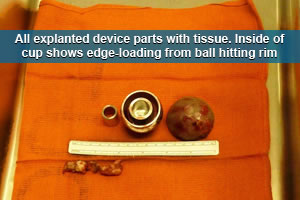 reasons. He told me
the hospital would not release them to me until it cleared hospital legal
but that he would get them and in turn, would give it to me – not
the most relaxed way to go into surgery but at least I knew he would
take care of it. I also gave him my digital camera in a zip lock bag
to take pictures.
reasons. He told me
the hospital would not release them to me until it cleared hospital legal
but that he would get them and in turn, would give it to me – not
the most relaxed way to go into surgery but at least I knew he would
take care of it. I also gave him my digital camera in a zip lock bag
to take pictures.

